Global AI Governance & Ethics Frameworks have become one of the most important world current affairs topics for students preparing for competitive examinations. With artificial intelligence rapidly transforming education, healthcare, defense, finance, and governance, countries across the world are working together to regulate AI responsibly.
For exams like UPSC, SSC, Banking, NDA, CDS, State PSCs, and school-level GK, understanding Global AI Governance & Ethics Frameworks is now essential.
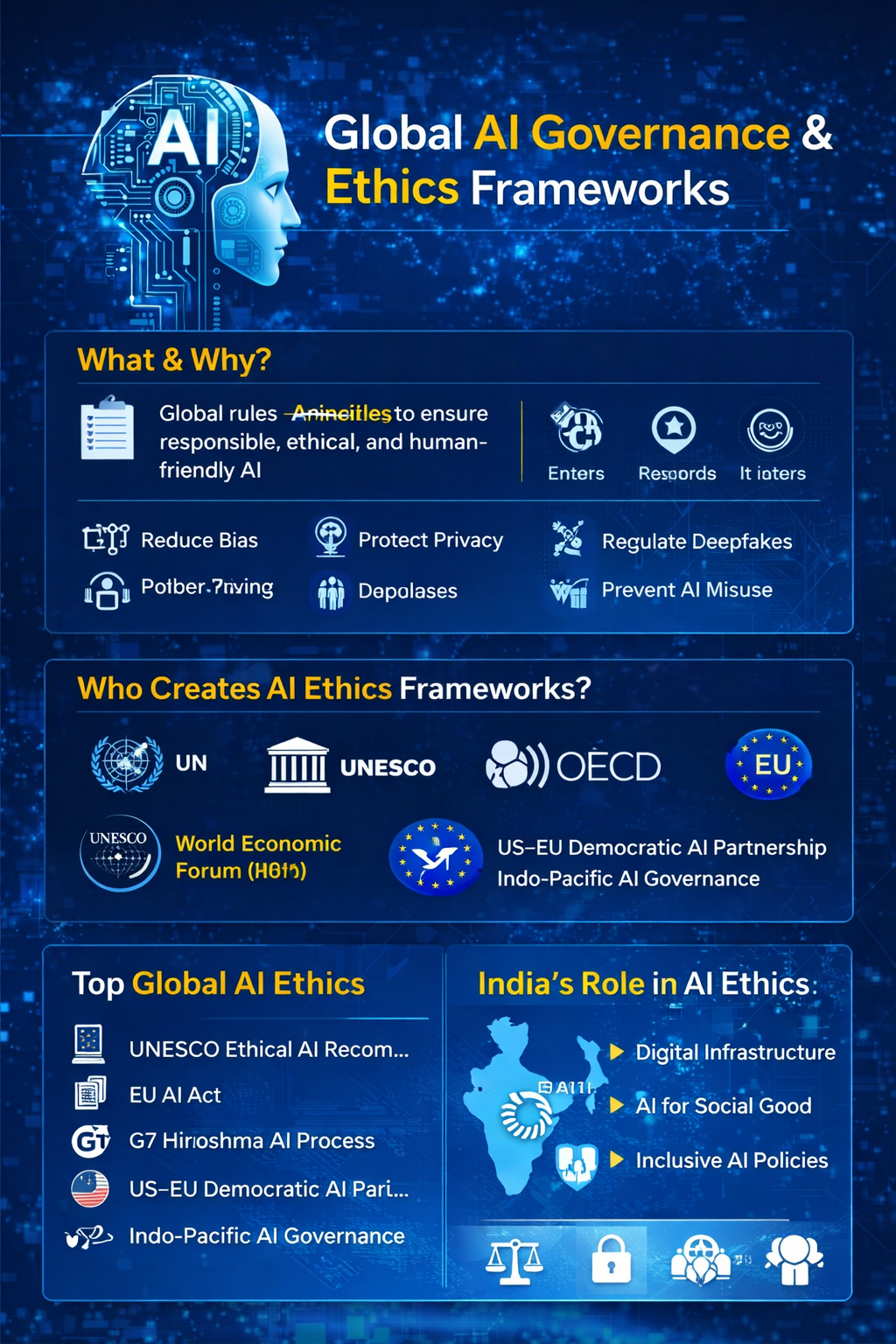
What Are Global AI Governance & Ethics Frameworks?
Global AI Governance & Ethics Frameworks refer to international rules, principles, policies, and ethical guidelines designed to ensure artificial intelligence is:
Safe
Transparent
Fair
Accountable
Human-centric
These frameworks aim to balance technological innovation with human rights, privacy, and security.
Why Global AI Governance & Ethics Frameworks Are Needed
The rise of AI has created several concerns, making Global AI Governance & Ethics Frameworks necessary:
Bias and discrimination in AI algorithms
Data privacy violations
Deepfakes and misinformation
Job displacement due to automation
Military use of autonomous weapons
Without strong Global AI Governance & Ethics Frameworks, AI could harm democratic values and social stability.
Key Organizations Shaping Global AI Governance & Ethics Frameworks
Several international institutions are leading efforts to strengthen Global AI Governance & Ethics Frameworks:
1️⃣ United Nations (UN)
The UN promotes ethical AI aligned with human rights and sustainable development goals.
2️⃣ UNESCO
UNESCO adopted the Recommendation on the Ethics of Artificial Intelligence, a landmark document under Global AI Governance & Ethics Frameworks.
3️⃣ OECD
The OECD AI Principles emphasize transparency, accountability, and responsible innovation.
4️⃣ World Economic Forum (WEF)
WEF encourages public-private cooperation under Global AI Governance & Ethics Frameworks.
🌐 Major Global AI Governance & Ethics Frameworks in the World
✅ UNESCO AI Ethics Recommendation
First global ethical framework on AI
Focuses on human dignity and equality
✅ European Union AI Act
Categorizes AI based on risk
Bans unacceptable AI practices
✅ G7 Hiroshima AI Process
Promotes safe and trustworthy AI
✅ US–EU & Indo-Pacific AI Cooperation
Focus on democratic values and ethical AI
All these initiatives strengthen Global AI Governance & Ethics Frameworks worldwide.
🇮🇳 India’s Role in Global AI Governance & Ethics Frameworks
India plays a growing role in Global AI Governance & Ethics Frameworks through:
Digital Public Infrastructure
AI for social good
Advocacy for inclusive and affordable AI
India supports responsible AI that benefits developing nations.
📚 Importance of Global AI Governance & Ethics Frameworks for Students
For students, Global AI Governance & Ethics Frameworks are important because:
Frequently asked in exams
Linked to science & technology syllabus
Relevant for essays and interviews
Crucial for future careers in tech and policy
MCQs on Global AI Governance & Ethics Frameworks
1. What is the main objective of Global AI Governance & Ethics Frameworks?
A) Promote unchecked AI growth
B) Ensure responsible and ethical AI use
C) Replace human decision-making
D) Ban artificial intelligence
✅ Answer: B
2. Which organization adopted the Recommendation on AI Ethics?
A) WHO
B) UNESCO
C) IMF
D) WTO
✅ Answer: B
3. Which region introduced the AI Act?
A) ASEAN
B) European Union
C) African Union
D) SAARC
✅ Answer: B
4. Which issue is addressed by Global AI Governance & Ethics Frameworks?
A) Climate change only
B) Space exploration
C) Algorithmic bias
D) Ocean pollution
✅ Answer: C
5. Which forum launched the Hiroshima AI Process?
A) G20
B) BRICS
C) G7
D) SCO
✅ Answer: C
6. AI governance mainly focuses on which principle?
A) Profit maximization
B) Human-centric development
C) Military dominance
D) Corporate secrecy
✅ Answer: B
7. Which of the following is a risk of unethical AI?
A) Improved accuracy
B) Faster services
C) Data misuse
D) Automation efficiency
✅ Answer: C
8. Which country strongly supports democratic AI values?
A) India
B) China
C) Russia
D) North Korea
✅ Answer: A
9. What does ethical AI promote?
A) Transparency
B) Accountability
C) Fairness
D) All of the above
✅ Answer: D
10. Which exams include Global AI Governance & Ethics Frameworks?
A) UPSC
B) SSC
C) Banking
D) All of the above
✅ Answer: D
11. Which principle ensures AI decisions can be understood by humans?
A) Automation
B) Transparency
C) Speed
D) Scalability
✅ Answer: B
12. AI ethics primarily aim to protect which value?
A) Corporate profit
B) Human dignity
C) Market competition
D) Technological monopoly
✅ Answer: B
13. Which global body focuses on AI ethics for education and culture?
A) IMF
B) WTO
C) UNESCO
D) World Bank
✅ Answer: C
14. Bias in AI systems is mainly caused by
A) Hardware failure
B) Poor internet
C) Biased training data
D) Low computing power
✅ Answer: C
15. Which AI practice is considered “high-risk” under EU AI regulations?
A) Video games
B) Facial recognition
C) Spell checkers
D) Music apps
✅ Answer: B
16. Which sector requires strict AI ethical oversight?
A) Entertainment
B) Healthcare
C) Gaming
D) Advertising
✅ Answer: B
17. Deepfakes mainly threaten which democratic value?
A) Transparency
B) Accountability
C) Free and fair elections
D) Innovation
✅ Answer: C
18. What does “human-in-the-loop” mean in AI governance?
A) AI replaces humans
B) Human supervision over AI decisions
C) Fully automated AI
D) Manual coding only
✅ Answer: B
19. Which forum promotes global cooperation on ethical AI?
A) SAARC
B) World Economic Forum
C) OPEC
D) ASEAN
✅ Answer: B
20. AI accountability refers to
A) Faster algorithms
B) Clear responsibility for AI outcomes
C) Reduced costs
D) Automatic updates
✅ Answer: B
21. Which of the following is a goal of AI governance?
A) Unrestricted AI use
B) Ethical and safe AI deployment
C) AI militarization
D) Corporate secrecy
✅ Answer: B
22. Which country emphasizes “AI for social good” in global forums?
A) India
B) Germany
C) Japan
D) France
✅ Answer: A
23. Autonomous weapons are a concern under which framework?
A) Space law
B) Cyber law
C) Global AI Governance & Ethics Frameworks
D) Trade law
✅ Answer: C
24. Data privacy in AI systems is protected through
A) Ethical guidelines
B) Faster processing
C) Open-source code
D) Automation
✅ Answer: A
25. Which principle ensures AI does not discriminate?
A) Efficiency
B) Fairness
C) Speed
D) Profitability
✅ Answer: B
26. Ethical AI frameworks help in building
A) Public trust
B) Market dominance
C) Corporate secrecy
D) Technological monopoly
✅ Answer: A
27. Which of the following is a key challenge in AI governance?
A) Lack of innovation
B) Rapid technological change
C) Excess manpower
D) Over-regulation of humans
✅ Answer: B
28. Global AI Governance & Ethics Frameworks mainly support
A) Authoritarian control
B) Human-centric AI development
C) Military expansion
D) Data exploitation
✅ Answer: B
29. Which exam frequently asks questions on AI ethics?
A) UPSC
B) SSC
C) Banking
D) All of the above
✅ Answer: D
30. The ultimate goal of Global AI Governance & Ethics Frameworks is
A) Replace human intelligence
B) Ensure sustainable and responsible AI
C) Promote AI monopolies
D) Ban artificial intelligence
✅ Answer: B
Positive Impact of Global AI Governance & Ethics Frameworks
Global AI Governance & Ethics Frameworks promote trust, fairness, and inclusive growth. They ensure AI supports education, healthcare, and development while protecting human values. For students, this topic represents the future of ethical technology leadership.
Global AI Governance & Ethics Frameworks play a crucial role in shaping a responsible, transparent, and human-centric future of artificial intelligence. As AI technologies rapidly influence governance, education, healthcare, security, and economies worldwide, the need for strong ethical standards and global cooperation has never been more important.
By promoting principles such as fairness, accountability, transparency, data privacy, and human oversight, Global AI Governance & Ethics Frameworks ensure that technological progress does not come at the cost of human rights or social trust. These frameworks help governments and institutions balance innovation with responsibility, making AI a force for inclusive growth and sustainable development.
For students and competitive exam aspirants, understanding Global AI Governance & Ethics Frameworks is essential, as this topic is increasingly featured in UPSC, SSC, Banking, State PCS, and international affairs examinations. Staying informed empowers learners to not only score better in exams but also to become responsible digital citizens in an AI-driven world.
In conclusion, Global AI Governance & Ethics Frameworks are not just policy tools—they are the foundation for a safe, equitable, and future-ready global AI ecosystem
