Republic Day History & Importance in India is one of the most essential topics for students, competitive exam aspirants, and anyone preparing for general knowledge, essays, or school assemblies. Celebrated every year on 26 January, Republic Day marks the historic moment when India became a sovereign democratic republic with the adoption of its Constitution.
Understanding the Republic Day History & Importance in India helps students appreciate constitutional values, democratic principles, and the sacrifices that shaped modern India.
What Is Republic Day?
Republic Day is a national festival that commemorates the day the Constitution of India came into force on 26 January 1950. While India gained independence on 15 August 1947, the country officially became a republic when its own constitution replaced the Government of India Act, 1935.
The Republic Day History & Importance in India highlights the transition from colonial rule to a nation governed by its own laws and democratic framework.
Republic Day History & Importance in India: Historical Background
To fully understand the Republic Day History & Importance in India, it is essential to look at its historical roots:
On 26 January 1930, the Indian National Congress declared Purna Swaraj (Complete Independence).
After independence, a Constituent Assembly was formed to draft India’s Constitution.
Dr. B. R. Ambedkar, the chief architect of the Constitution, played a pivotal role.
The Constitution was adopted on 26 November 1949 and implemented on 26 January 1950.
Thus, the Republic Day History & Importance in India is deeply connected to India’s freedom struggle and constitutional development.
Why Is Republic Day Celebrated on 26 January?
Many students wonder why Republic Day is not celebrated on 15 August. The Republic Day History & Importance in India explains that:
26 January was chosen to honor the Purna Swaraj declaration of 1930.
It symbolized India’s complete independence from British authority.
The date represents national unity and democratic self-rule.
This decision strengthened the symbolic value of the Republic Day History & Importance in India.
Republic Day History & Importance in India for Students
For students, the Republic Day History & Importance in India is especially important because:
It is frequently asked in GK, SSC, UPSC, banking, and state exams
It forms a common essay and speech topic
It builds awareness of constitutional values
It strengthens understanding of citizens’ rights and duties
Knowing the Republic Day History & Importance in India helps students perform better in academics and competitive exams.
Importance of the Indian Constitution on Republic Day
A key aspect of the Republic Day History & Importance in India is the Constitution itself. The Indian Constitution:
Is the longest written constitution in the world
Guarantees Fundamental Rights
Establishes Directive Principles of State Policy
Defines Fundamental Duties
Ensures justice, liberty, equality, and fraternity
The Republic Day History & Importance in India reminds citizens that the Constitution is the backbone of Indian democracy.
Republic Day Celebrations in India
The grand celebrations further highlight the Republic Day History & Importance in India:
1. Republic Day Parade
Held at Kartavya Path (formerly Rajpath) in New Delhi, the parade showcases:
Military strength
Cultural diversity of Indian states
Technological and defense achievements
2. State Tableaux
Each state presents tableaux reflecting culture, heritage, and development, reinforcing the Republic Day History & Importance in India.
3. Awards and Honors
Bravery awards such as Param Vir Chakra and Ashoka Chakra are presented.
Republic Day History & Importance in India: National Unity & Patriotism
The Republic Day History & Importance in India lies not only in history but also in its emotional significance:
Promotes unity in diversity
Strengthens national identity
Inspires respect for democratic institutions
Encourages responsible citizenship
Republic Day unites people across regions, religions, and languages under one Constitution.
Republic Day History & Importance in India for Competitive Exams
For competitive exam aspirants, the Republic Day History & Importance in India is a high-scoring topic:
Asked in MCQs
Appears in current affairs and static GK
Important for essay and interview rounds
Students preparing for UPSC, SSC, and state exams should thoroughly revise the Republic Day History & Importance in India.
Republic Day vs Independence Day
Understanding the difference strengthens clarity on the Republic Day History & Importance in India:
| Independence Day | Republic Day |
|---|---|
| Celebrated on 15 August | Celebrated on 26 January |
| Marks freedom from British rule | Marks adoption of Constitution |
| End of colonial rule | Beginning of democratic governance |
Role of Citizens on Republic Day
The Republic Day History & Importance in India also reminds citizens of their responsibilities:
Upholding constitutional values
Respecting national symbols
Following laws and duties
Promoting harmony and unity
Republic Day is not just a celebration but a reminder of civic responsibility.
Republic Day History & Importance in India: Educational Value
Schools and colleges emphasize the Republic Day History & Importance in India through:
Speeches
Essay competitions
Cultural programs
Quiz contests
These activities instill patriotism and constitutional awareness among students.
1. Republic Day and the Making of the Indian Constitution
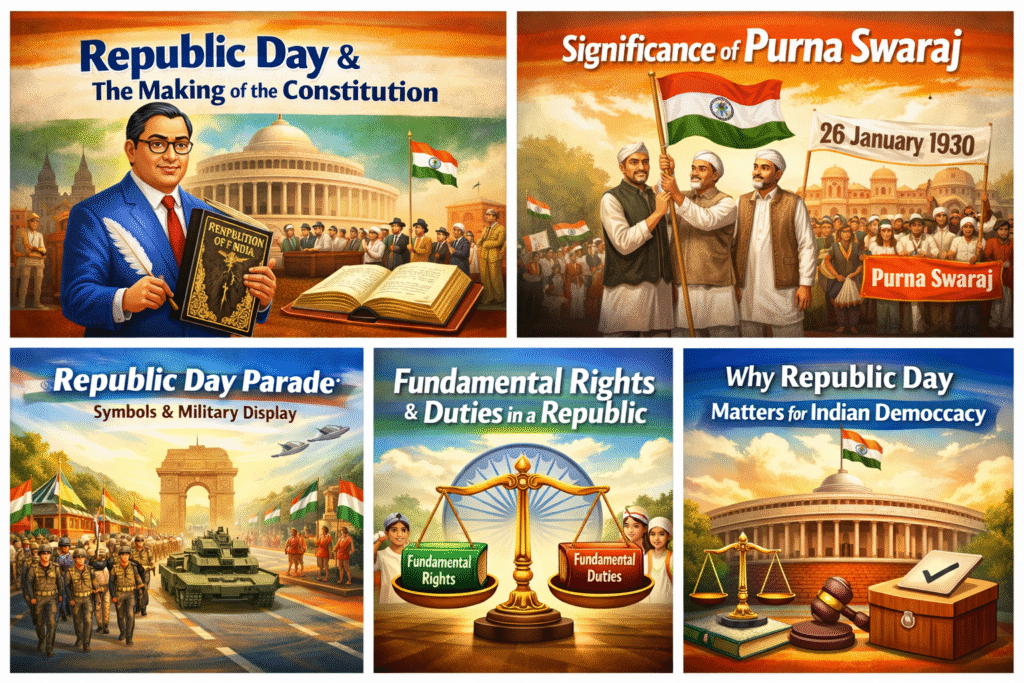
After independence, India needed a legal framework to govern the country. The Constituent Assembly was formed in 1946 to draft the Constitution. Several committees were set up to work on different aspects such as fundamental rights, union powers, and federal structure. Dr. B. R. Ambedkar, as Chairman of the Drafting Committee, played a crucial role in shaping the Constitution. Republic Day marks the day when this Constitution came into force, making India a republic.
2. Significance of Purna Swaraj in Republic Day History
Purna Swaraj, meaning complete independence, was declared on 26 January 1930 by the Indian National Congress. This declaration rejected British rule and demanded full freedom. Even before independence, 26 January became a symbol of national resolve. Choosing this date for Republic Day honored the struggle for complete independence and linked the Constitution to the freedom movement.
3. Republic Day Parade: Symbols, Tableaux, and Military Display
The Republic Day parade is a major national event held in New Delhi. It features colorful tableaux representing different states and their cultural heritage, social themes, and development achievements. The armed forces participate through marching contingents, weapon displays, and fly-pasts. The parade reflects national pride, unity, and India’s defense strength.
4. Role of Fundamental Rights and Duties in a Republic
Fundamental Rights ensure equality, freedom, and justice for citizens, while Fundamental Duties remind people of their responsibilities toward the nation. A republic functions well only when citizens enjoy rights and also fulfill duties such as respecting laws, national symbols, and promoting harmony. Republic Day highlights this balance between rights and responsibilities.
5. Why Republic Day Is Important for Indian Democracy
Republic Day marks the beginning of democratic governance in India. It signifies that the country is governed by its own Constitution rather than colonial laws. The day reinforces democratic values like equality before law, participation of citizens, and rule of law, which are essential for a functioning democracy.
6. Republic Day Celebrations in Schools and Educational Institutions
Schools and colleges celebrate Republic Day through flag hoisting, speeches, cultural programs, debates, and competitions. These activities help students learn about national values, constitutional principles, and the importance of democracy while building a sense of patriotism and unity.
7. Republic Day vs Independence Day: Key Differences Explained
Independence Day marks freedom from British rule on 15 August 1947, while Republic Day marks the adoption of the Constitution on 26 January 1950. Independence Day celebrates political freedom, whereas Republic Day celebrates democratic governance and constitutional authority. Understanding this difference is important for exams.
8. Republic Day and National Integration in India
Republic Day promotes national integration by bringing together people from different regions, cultures, religions, and languages. Cultural performances and state tableaux showcase India’s diversity while reinforcing the idea of unity and shared national identity.
9. Constitution Day vs Republic Day: Know the Difference
Constitution Day is observed on 26 November to mark the adoption of the Constitution in 1949. Republic Day is celebrated on 26 January, the day the Constitution came into effect. Both days are important but serve different purposes, and this distinction is often tested in GK exams.
10. Republic Day Awards and National Honors
On Republic Day, the government announces national honors such as Padma Awards and gallantry awards. These awards recognize outstanding contributions in fields like arts, science, social service, and acts of bravery. They encourage excellence and service to the nation.
11. Republic Day Essay Topics for Students
Republic Day provides many meaningful essay topics, such as democracy, Constitution, national unity, freedom struggle, and civic responsibility. Writing on these themes helps students develop awareness of national values and perform well in exams and competitions.
12. Republic Day Speech Ideas for School Assemblies
Students deliver speeches on Republic Day focusing on history, democratic values, unity, and patriotism. Speech topics vary by age group and help students improve public speaking skills while deepening their understanding of national significance.
13. Republic Day MCQs for Competitive Exams
Republic Day is a frequently asked topic in competitive exams. Questions usually cover dates, constitutional facts, committees, awards, and celebrations. Practicing such MCQs helps students score better in SSC, UPSC, banking, and state-level exams.
14. Republic Day and Citizen Responsibilities
Republic Day reminds citizens that democracy survives through responsible behavior. Citizens must respect laws, uphold constitutional values, and contribute positively to society. Ethical citizenship is essential for national progress and democratic stability.
15. How Republic Day Strengthens Indian National Identity
Republic Day strengthens national identity by reminding citizens of shared history, constitutional ideals, and collective responsibility. It builds pride in democratic institutions and reinforces the idea of India as a united nation.
Conclusion
The Republic Day History & Importance in India represents the soul of Indian democracy. It marks the day when India truly became a republic, governed by the will of its people through a powerful Constitution. For students, understanding this topic is essential not only for exams but also for becoming informed, responsible citizens.
Republic Day reminds every Indian that freedom comes with responsibility, rights come with duties, and democracy thrives when citizens respect the Constitution.

One Response