The IndiaAI face-authentication challenge for public examinations has been officially launched by the Government of India with a prize pool of ₹2.5 crore. The initiative aims to develop a robust, AI-powered face-authentication system to prevent identity fraud and impersonation during high-stakes public exams such as UPSC, SSC, NEET, and JEE.
This challenge is part of India’s broader “Digital India” and “AI for All” mission, emphasizing ethical and secure applications of artificial intelligence in governance. For students, researchers, and tech innovators, this marks a new chapter in how AI can be used to enhance transparency, fairness, and accountability in the education sector.
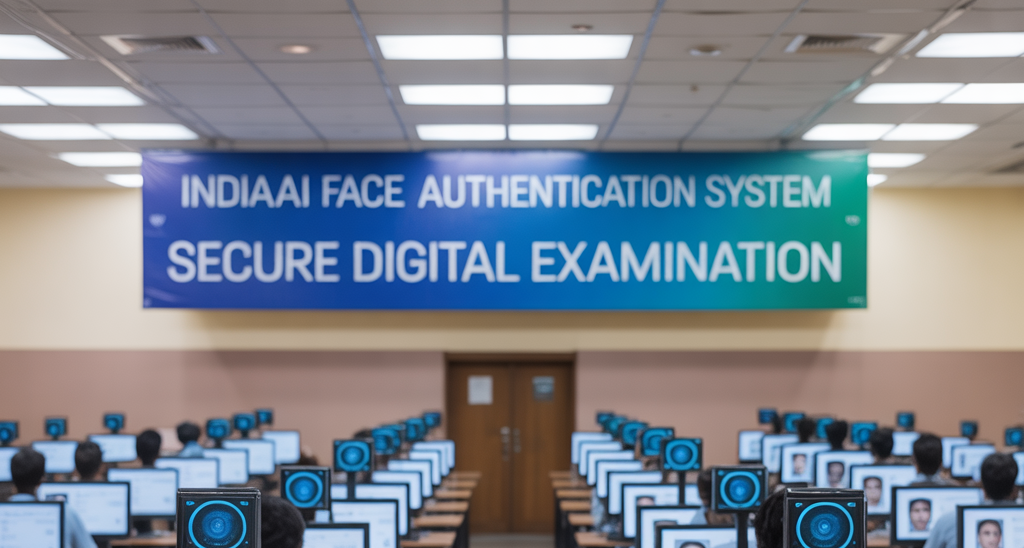
Objectives of the IndiaAI Face-Authentication Challenge for Public Examinations
The IndiaAI face-authentication challenge for public examinations has a multi-dimensional purpose that goes beyond technology innovation. Its goals include:
✅ Developing an AI-based facial recognition model that works under real-world conditions — poor lighting, varied camera angles, and different ethnic or demographic profiles.
✅ Ensuring secure and tamper-proof verification of candidates during online or offline public exams.
✅ Promoting indigenous AI development, encouraging Indian startups, research labs, and students to create ethical tech solutions.
✅ Reducing exam malpractice and impersonation, a rising concern in digital exam environments.
✅ Building trust and transparency in national recruitment and academic evaluation processes.
This initiative empowers students and AI enthusiasts to apply machine learning and computer vision skills to a real societal challenge.
💡 Why It Matters: The Growing Need for AI-Driven Exam Security
Every year, millions of Indian students appear for public examinations — from government recruitment tests to competitive academic assessments. With this massive scale, exam fraud becomes a critical challenge.
The IndiaAI face-authentication challenge for public examinations directly addresses these problems by creating an AI-based verification system that ensures:
👩💻 Identity authenticity during exam login or hall entry
🧾 Real-time monitoring during online or remote tests
🔒 Data privacy and security through encrypted biometric storage
🕵️ Detection of impersonation using AI pattern matching
By integrating such tools, India aims to modernize its examination ecosystem while maintaining fairness and inclusivity.
🧭 How the IndiaAI Face-Authentication Challenge Works
The IndiaAI face-authentication challenge for public examinations follows a three-phase structure:
Phase 1 – Conceptualization:
Participants propose algorithms, datasets, and ethical frameworks. Submissions are evaluated on innovation, inclusivity, and data protection.Phase 2 – Prototype Development:
Shortlisted teams build a working prototype capable of identifying and verifying candidates across various testing conditions.Phase 3 – Field Testing & Integration:
Finalists demonstrate real-time use cases of their system in simulated or partnered examination environments.
Winning teams receive part of the ₹2.5 crore prize pool along with incubation support, mentorship, and potential collaboration with national exam authorities.
⚙️ Key Stakeholders Involved
The IndiaAI face-authentication challenge for public examinations is a joint initiative involving:
IndiaAI Mission – the nodal agency for AI innovation in India
Ministry of Electronics and Information Technology (MeitY) – providing policy and funding support
National e-Governance Division (NeGD) – ensuring data security and ethical AI use
Academic Institutions & Startups – contributing AI algorithms, datasets, and research insights
This collaboration ensures a multi-sectoral approach that blends policy, research, and real-world application.
🌐 Impact on Students and Education Ecosystem
The IndiaAI face-authentication challenge for public examinations offers direct benefits for students, institutions, and the education system at large:
🎓 For Students
Encourages participation in AI innovation and problem-solving competitions.
Enhances awareness about ethical technology and data privacy.
Opens new career pathways in AI research, cybersecurity, and ed-tech.
🏫 For Institutions
Enables adoption of smart examination systems powered by AI.
Reduces administrative load during identity verification.
Promotes collaboration between tech developers and educational boards.
🏢 For the Government
Strengthens the credibility of national-level examinations.
Demonstrates India’s leadership in AI governance and digital inclusion.
Ensures cost-effective and transparent evaluation mechanisms.
Positive and Negative Impacts
The IndiaAI face-authentication challenge for public examinations is one of the most transformative initiatives launched under India’s AI for Governance vision. While the project has immense potential to revolutionize exam security and fairness, it also brings new challenges related to privacy, inclusivity, and implementation. Let’s examine both sides in detail.
✅ Positive Impacts
1. Boosts Exam Integrity
One of the biggest benefits of the IndiaAI face-authentication challenge for public examinations is its potential to eliminate impersonation and fraudulent activities in exam systems.
Traditionally, competitive exams in India — like UPSC, NEET, and SSC — have struggled with cases of cheating, proxy candidates, and fake IDs. By using AI-driven facial verification, authorities can confirm that the person taking the test is indeed the registered candidate.
This ensures exam integrity and fairness, allowing genuine students to compete without fear of manipulation. AI can also detect suspicious login behavior or facial inconsistencies in real-time, reducing human error and manual verification delays.
2. Empowers Indian Innovators
The IndiaAI face-authentication challenge for public examinations opens doors for Indian AI startups, researchers, and students to showcase their skills. With a ₹2.5 crore reward, it motivates innovators to build indigenous, ethical, and cost-effective AI solutions instead of relying on foreign technology.
This push strengthens India’s AI ecosystem, encourages entrepreneurship, and nurtures a talent pipeline in computer vision and machine learning.
Students participating in this challenge not only enhance their technical skills but also learn about data ethics, model fairness, and responsible innovation — areas vital for the future of digital India.
3. Enhances Transparency
Transparency has always been a concern in large-scale examinations. The IndiaAI face-authentication challenge for public examinations promises to bring digital transparency and auditability to the process.
AI systems can record each verification attempt, flag irregularities, and generate audit trails. This reduces manual manipulation and builds public trust in exam outcomes.
Additionally, digital logs can serve as evidence in disputes, ensuring every decision — from admit card verification to result declaration — is backed by data-driven transparency.
4. Protects Data Security
While facial recognition involves sensitive biometric data, the IndiaAI face-authentication challenge for public examinations emphasizes encrypted storage and ethical data management.
Participants are required to comply with India’s emerging AI ethics framework and proposed Data Protection Act, ensuring that all facial data is anonymized, stored securely, and deleted after verification.
This marks a major shift toward privacy-first AI deployment, protecting students’ personal data from misuse. The use of open testing standards also allows developers to build systems that are auditable and compliant with government norms.
5. Drives Global Recognition
The IndiaAI face-authentication challenge for public examinations not only strengthens domestic infrastructure but also enhances India’s international standing in ethical AI governance.
Countries worldwide — including the U.S., U.K., and South Korea — are exploring similar AI-based verification models for exams and e-governance. India’s leadership in this area can serve as a benchmark for AI innovation in developing nations.
If implemented successfully, this project can make India a global model for secure, transparent, and inclusive exam systems, showcasing how technology can balance innovation with ethics.
⚠️ Potential Challenges
1. Data Privacy Risks
While AI verification enhances security, it also raises concerns about biometric data privacy. Facial data is highly personal and, if mishandled, can lead to identity theft or surveillance misuse.
The IndiaAI face-authentication challenge for public examinations therefore must ensure strict data governance — including anonymization, limited data retention, and secure transmission protocols.
To maintain student trust, developers must adopt transparent consent mechanisms, allowing examinees to understand how their facial data is collected, processed, and deleted.
Without strong oversight, this innovation could risk turning into a privacy concern, especially if data is stored for extended periods or used beyond the original purpose.
2. Technical Biases
AI facial-recognition systems can sometimes display algorithmic bias — performing better on certain skin tones, genders, or ethnic groups than others.
If not properly trained on diverse datasets, these systems could misidentify students from underrepresented backgrounds or regions.
The IndiaAI face-authentication challenge for public examinations highlights this issue by encouraging participants to use inclusive datasets representing India’s demographic diversity.
To achieve fairness, developers must validate their models across varied lighting, facial expressions, and camera types — ensuring equitable accuracy for all examinees, regardless of background.
3. Implementation Costs
Rolling out AI-based authentication systems across millions of candidates and thousands of exam centers is no small feat. Hardware costs (like high-resolution cameras and servers), software licensing, and maintenance could make the initial phase expensive.
While the long-term savings — from reduced fraud and manual errors — will offset these costs, small examination bodies might find it financially challenging at first.
Thus, the IndiaAI face-authentication challenge for public examinations needs to ensure scalability and cost-efficiency, possibly through open-source tools and shared digital infrastructure.
4. Training Needs
Technology adoption is not just about systems — it’s also about people.
For the IndiaAI face-authentication challenge for public examinations to succeed, administrators, invigilators, and technical staff need proper training to operate and troubleshoot these AI systems.
Without sufficient capacity-building, implementation may face resistance or operational errors.
Hence, government agencies must design training modules for teachers, exam staff, and IT departments to ensure smooth adoption. This also creates new job opportunities in AI system management and cyber ethics education.
🧩 Balancing Innovation with Responsibility
Despite these challenges, the IndiaAI face-authentication challenge for public examinations takes proactive steps to mitigate risks.
Its emphasis on ethical AI design, open testing standards, and inclusive participation ensures that innovation does not come at the cost of privacy or equity.
By combining strong data protection laws, public awareness, and technical excellence, India is setting the foundation for a secure, transparent, and student-friendly exam ecosystem powered by AI.
🧩 Key Takeaways
| Aspect | Details |
|---|---|
| Initiative Name | IndiaAI Face-Authentication Challenge for Public Examinations |
| Funding | ₹2.5 Crore |
| Objective | Secure and verify student identities in public exams using AI |
| Organizers | MeitY, NeGD, IndiaAI Mission |
| Benefits | Transparency, exam security, innovation |
| Participants | Students, startups, research labs |
| Future Vision | Nationwide adoption of AI-based exam systems |
❓ FAQs on IndiaAI Face-Authentication Challenge for Public Examinations
1. What is the IndiaAI face-authentication challenge for public examinations?
It’s a government initiative to develop AI-based facial verification systems ensuring fairness and security in major exams like UPSC, NEET, and JEE.
2. Who can participate in the IndiaAI face-authentication challenge for public examinations?
Students, AI startups, and research institutions across India are eligible to participate and submit innovative models.
3. What is the prize amount for the IndiaAI face-authentication challenge for public examinations?
The total prize pool is ₹2.5 crore, distributed among winning teams based on innovation and real-world applicability.
4. How will this challenge benefit students?
It promotes AI skill development, real-world innovation, and opens opportunities in the growing AI and ed-tech sectors.
5. What are the data privacy measures in place?
The initiative enforces strict ethical AI guidelines and encryption protocols to protect student biometric information.
6. When will the results of the IndiaAI face-authentication challenge for public examinations be announced?
Official timelines and evaluation phases will be announced on the IndiaAI official portal and MeitY’s website.
7. What is the long-term goal of this challenge?
To build a tamper-proof, AI-enabled exam ecosystem that ensures fairness, trust, and inclusivity across all national and state-level examinations.
The IndiaAI face-authentication challenge for public examinations is more than a tech contest — it’s a transformational step toward digital trust in education. By integrating AI verification systems, India can eliminate identity fraud, enhance exam credibility, and empower a new generation of innovators.
For students, it’s not just about learning AI — it’s about applying knowledge to build a fairer, smarter, and more secure education system.

Nice