In a landmark move that marks a turning point for the nation, India Begins First Fully Digital Census 2025 — a step that promises to revolutionize how the country collects, processes, and utilizes demographic data. As the world’s largest democracy steps into a new era of e-governance, the digital census is set to deliver more accurate, real-time, and inclusive population insights than ever before.
The initiative aligns with India’s digital transformation journey under Digital India, shaping smarter governance and bridging long-standing gaps in national development planning. Because this is the first time India Begins First Fully Digital Census 2025, the process introduces new tools, applications, and secure digital technologies to make census operations faster, safer, and more reliable.
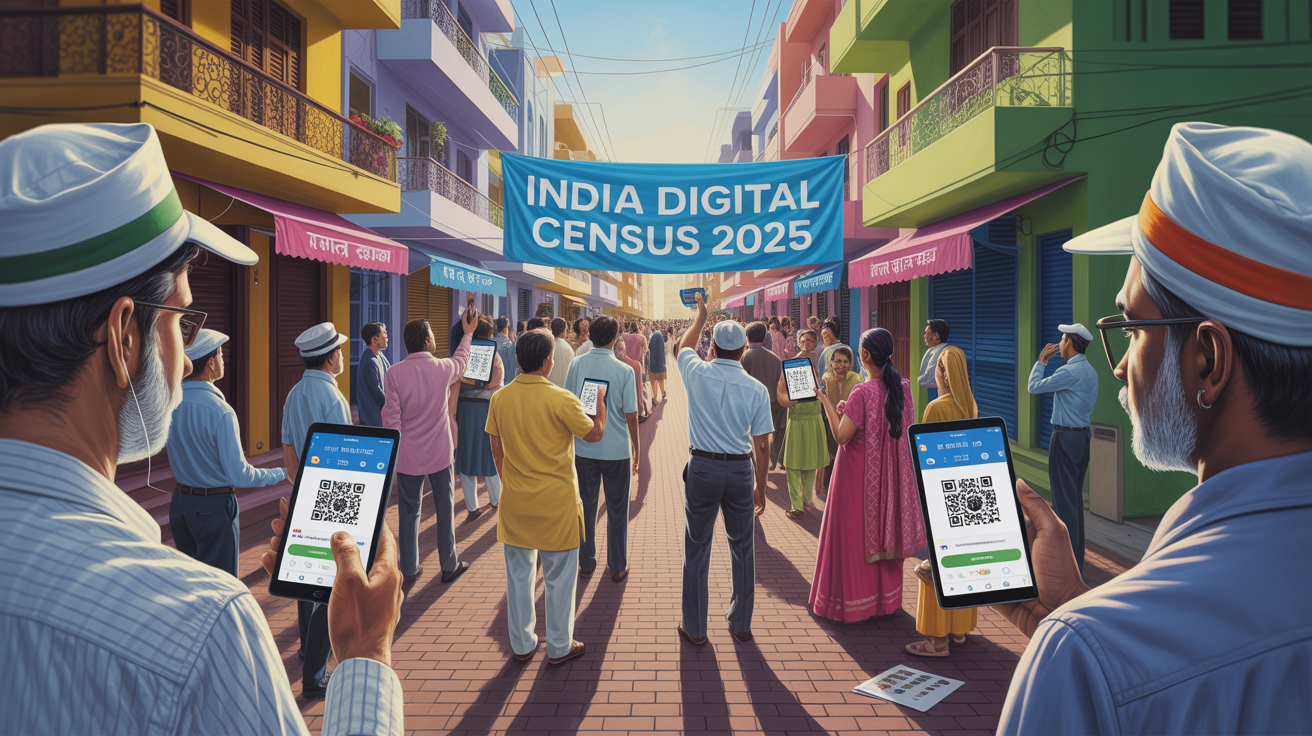
Why India Begins First Fully Digital Census 2025 Is a Big Deal
The digital census is not just an administrative upgrade — it’s a giant leap toward 21st-century governance. By using smartphones, tablets, geotagging, and online verification, the government ensures a more accurate and inclusive national population record.
Here’s why the announcement that India Begins First Fully Digital Census 2025 is grabbing national attention:
✔️ Faster Data Processing
Unlike traditional manual forms, digital entries allow instant syncing and verification.
✔️ Enhanced Accuracy
Real-time data reduces duplication, missing entries, and human error.
✔️ Transparency & Accountability
Geotagged surveys and mobile applications ensure every household is counted.
✔️ Cost Efficiency
Digital processing significantly cuts printing, storage, and manual inspection costs.
✔️ Direct Integration With Public Schemes
Makes welfare schemes more targeted and efficient.
How India Begins First Fully Digital Census 2025: Step-by-Step Process
1) Enumerators use mobile apps — more than just a digital form
At face value, handing tablets to enumerators sounds simple. In reality the app + device ecosystem is the core of the operation.
What the app must do
Guided workflows. Step-by-step questionnaires with conditional branching (show Qs only when relevant).
Offline-first design. Work smoothly without internet; store encrypted records locally and sync when network is available.
Input validation. Real-time checks (e.g., age vs. DOB consistency, mandatory fields) to reduce garbage data.
Multimedia capture. Photos for landmark verification (not personal ID photos), audio prompts for low-literacy contexts.
Role-based access. Enumerators only see features they need; supervisors have extra tools for review.
Audit logs. Every change stamped with enumerator ID, time, and device ID for traceability.
Training & operations
Intensive training is essential: device handling, app navigation, ethical rules, consent practices, troubleshooting.
Helpdesk & escalation: live support (phone + chat) for field issues and device failures.
Device management: Mobile Device Management (MDM) to push updates, remotely wipe lost devices, and keep software secure.
Why this matters
Good app/device design reduces human error, speeds collection, and enables near real-time supervision — which is why the enumerator app is the linchpin of India Begins First Fully Digital Census 2025.
2) GPS & geotagging for accuracy — mapping every household precisely
Geotagging ties each household record to a precise location. That has technical and governance benefits — and privacy implications.
How it’s used
Point verification: Capture GPS coordinates for the household or dwelling to avoid duplicate counting and to map coverage.
Enumeration mapping: District/state officials can see which clusters are done and which need revisits.
Boundary validation: Compare against existing administrative maps to identify misaligned or newly developed areas.
Accuracy & mitigations
GPS can be noisy in dense urban areas or indoors; the system should:
Accept assisted-GPS or manual map-pin correction when needed, with supervisor review.
Record GPS accuracy metadata so analysts can flag low-accuracy points.
Privacy safeguards: store coordinates in encrypted form and use access controls; consider storing a less precise centroid for public release (to protect household privacy).
Why this matters
Geotagging transforms census results from paper lists into spatial data that planners can use for service delivery, disaster planning, and mapping underserved pockets — a key advantage of India Begins First Fully Digital Census 2025.
3) Real-time uploading — speed + challenges
Uploading data as it’s collected enables monitoring and rapid quality checks — but it requires a resilient technical stack.
How it works
Sync model: App batches records locally, retries uploads automatically when connectivity returns.
Secure transmission: TLS/HTTPS + payload encryption. Devices authenticate with keys/certificates to prevent spoofing.
Server architecture: Cloud or hybrid architecture with autoscaling to handle bursts and to provide district-level dashboards.
Edge cases: For long offline periods, a physical courier of encrypted SD cards is a planned fallback.
Data integrity & speed
Checksums & acknowledgements ensure records aren’t corrupted during upload.
Prioritization: Critical fields uploaded first (household ID, geo, timestamps), heavier assets (photos) uploaded later when bandwidth allows.
Why this matters
Real-time uploads let supervisors catch mistakes quickly and measure progress. That’s one of the practical shifts when India Begins First Fully Digital Census 2025 moves from hours and weeks of manual entry to near-instant visibility.
4) Self-enumeration option — citizen participation & authentication
Allowing households to self-fill online speeds collection and increases agency — but it introduces authentication, inclusion, and verification issues.
Design elements
Secure login: OTP to mobile number or Aadhaar-based authentication (if legally cleared), with clear consent screens.
Progressive disclosure: Citizens can save and resume entries; they receive a temporary verification ID for follow-up.
Assisted kiosks: For households without devices, community kiosks or school computers with staff assistance can be offered.
Verification & reconciliation
Double-check: Self-filled entries are later validated by a field enumerator or via automated cross-checks (e.g., comparing with earlier records, geospatial plausibility).
De-duplication: Back-end algorithms flag duplicate or inconsistent entries for human review.
Inclusion considerations
Digital divide: Not everyone has internet or digital literacy. Self-enumeration should supplement, not replace, enumerator visits.
Accessibility: Simple language, multimedia aid (audio prompts), and multilingual UI are essential so self-enumeration is genuinely inclusive.
Why this matters
Self-enumeration modernizes the census and improves convenience — a central feature of India Begins First Fully Digital Census 2025 — but only if combined with strong verification and inclusion measures.
5) Multi-language support — real inclusion at scale
India’s linguistic diversity demands forms and interfaces that speak to people in their language.
Technical approach
Localization (L10n) not just translation: Local context matters — word choices, examples, and audio prompts must be culturally appropriate.
Unicode & fonts: Ensure proper display for Indic scripts and bidirectional text where needed.
Voice support: Text-to-speech in regional accents helps low-literacy users complete self-enumeration.
Quality control
Back translation & field testing: Translations must be pilot-tested in communities for clarity.
Regional glossaries: Terms (e.g., household, occupant) may have local variants — glossaries ensure consistent meaning.
Why this matters
Multi-language support is essential so the promise of India Begins First Fully Digital Census 2025 — inclusivity and accuracy — actually reaches all communities.
6) AI-based data verification — smarter quality control, not magic
AI helps sift huge volumes of entries to find anomalies — but it must be designed responsibly.
Common AI tasks
De-duplication: Match records that likely represent the same person or household (fuzzy name matching, address similarity, geo proximity).
Anomaly detection: Spot improbable values (e.g., age inconsistent with date of birth, impossible household sizes) for manual review.
Completeness scoring: Automatically score records for missing or inconsistent fields, prioritizing them for follow-up.
Human-in-the-loop
Review queues: AI flags are routed to human validators (supervisors/analysts) for context-aware decisions.
Bias & fairness: Algorithms must be tested to avoid systemic bias (e.g., against minority naming conventions or rural address formats).
Transparency & auditing
Explainability: Record why AI flagged an entry (which rules/metrics), so auditors can evaluate and correct model behavior.
Why this matters
AI speeds quality control at scale for India Begins First Fully Digital Census 2025, but the system must combine automation with human oversight to maintain trust and correctness.
Cross-cutting considerations: privacy, security, and ethics
Data privacy & legal framework
Legal safeguards must define what data is collected, who can access it, retention periods, and conditions for sharing.
Consent & transparency: Citizens should receive clear information on how their data will be used.
Anonymization for release: Public datasets should be aggregated or anonymized to prevent re-identification.
Cybersecurity
Encryption at rest and in transit.
Key management & HSMs (hardware security modules) for protecting encryption keys.
Penetration testing & bug bounties to find vulnerabilities before release.
Ethical use & oversight
An independent oversight body or audit mechanism increases public confidence in how the census data is managed and used.
Practical implementation notes & mitigations
Pilot, iterate, scale
Large pilots in diverse geographies (urban slums, hill districts, islands) reveal real-world issues before nationwide rollout.
Capacity building
Train tens of thousands of enumerators and supervisors, plus IT teams at district/state level. Provide multilingual manuals and video guides.
Connectivity & hardware fallback
Provide offline capabilities and local caching. Prepare portable hotspots, satellite uplinks, or courier options for the remotest areas.
Public communication campaign
Explain benefits, privacy protections, and step-by-step guides for self-enumeration. Use TV/radio, local influencers, and schools to reach citizens.
Who benefits — and how quickly will benefits show?
Short term (during/after enumeration)
Faster field monitoring, fewer missing pockets, more reliable coverage metrics.
Medium term (months after)
Faster release of basic tabulations to planners; rapid policy targeting (e.g., vaccination drives, ration distribution).
Long term
High-quality spatial demographic layers enabling targeted development, evidence-based policy, and better disaster response.
Quick checklists
For administrators (district/state level)
Ensure enumerator app passes pilot tests in all terrain types.
Verify secure server architecture and disaster recovery plans.
Publish clear privacy policy & access rules.
Set up 24×7 technical helpdesk and field support teams.
For citizens
If self-enumerating, keep documents handy (household list, IDs).
Use official portals only — beware of phishing.
Ask enumerators about consent and data use if approached.
Key Features of India Begins First Fully Digital Census 2025
Here are the primary features being implemented nationwide:
📱 • Mobile-Based Enumeration
Enumerators receive government tablets or smartphones with pre-loaded census software.
🔐 • End-to-End Encryption for Security
Data collected in the digital census is encrypted to prevent unauthorized access.
🕒 • Real-Time Dashboards for Monitoring
Officials can track census progress instantly across districts and states.
🧠 • AI and Machine Learning Integration
Automated analytics will categorize data faster than before.
🌍 • Environment Friendly
Millions of paper sheets eliminated — a sustainable choice.
All these innovations reflect how innovatively India Begins First Fully Digital Census 2025 compared to earlier censuses.
Challenges India Faces in Implementing a Fully Digital Census
Even as India Begins First Fully Digital Census 2025, certain challenges remain:
⚡ • Digital Infrastructure Gaps
Rural regions may face connectivity issues.
🎓 • Training Enumerators
Not all staff are digitally skilled, requiring extensive training.
🛡️ • Data Privacy Concerns
Ensuring secure handling of sensitive personal information is crucial.
🧑💼 • Public Awareness
Citizens need to trust and understand the digital census process.
Still, these challenges are being addressed through government training programs, better connectivity, and transparent communication.
🌟 Impact on India’s Future
As India Begins First Fully Digital Census 2025, the long-term effects will redefine governance:
✔ More accurate and fast policymaking
✔ Stronger welfare distribution
✔ Better planning for urbanization
✔ Improved tracking of economic and social indicators
✔ Modernized administrative systems
This digital shift also places India among the global leaders in census modernization.
The nationwide rollout of the India Begins First Fully Digital Census 2025 marks a historic milestone that promises to transform how India governs, plans, and envisions its future. By embracing a data-driven and technology-powered approach, the nation is taking a major step toward transparency and efficiency. From digital devices to AI-based verification, every component strengthens India’s position as a modern, digitally empowered nation.
In essence, India Begins First Fully Digital Census 2025 not only simplifies the census process but also lays the foundation for smarter and more inclusive development in the coming decade.

NICE POST
Crispy and cruchy knowledge ,keep it up